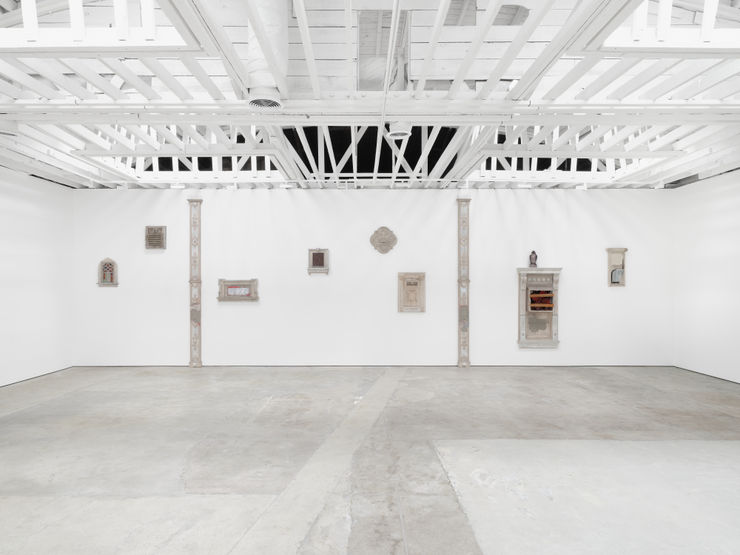
Malcolm Kenter "Composite Order": Los Angeles

In ancient Greek and Roman architectural traditions, orders were assigned by the ornamentation exemplified in the columns of the era. Distinctive capitals and fluting defined the orders, starting with the simple Doric, followed by the increasingly ornate Ionic and Corinthian. In time, these orders began to blur and compound on one another, and the combined motifs of Ionic and Corinthian were later deemed the Composite Order.
The genesis for the show and placing this theme of the Composite Order into context came from a moment when I observed a Romanesque pillar on the side of a shuttered storefront. A vent of unknown function hung defunct on the face of the pillar, and the passage of time was evident through the layers of paint that were piled upon it. I was struck by the colliding systems and doctrines that were evident. I was observing contradicting forces where both schools of thought had come to lay dormant and timeworn, as if I was a witness to a battlefield where both parties lay defeated. The classical revival architecture of the pillar seemed overly ornate, and echoed cheaply in this instance like architectural costume jewelry. The imposing vent form, however, revealed itself like a parasitic blemish, void of decoration or grace, a complete opposite of the grandeur of the pillar with which it occupied the same space. This collision resulted in something profound to me, the mask of materialistic splendor meeting on the same surface with defunct utility and the absence of spectacle. This suggestion of a societal duality exemplified in the infinite metaphor and vernacular of the built environment compelled me to make this body of work, a world of merging contradictions and anomalies. The rigidity and the ensuing entropy of a surface, the banal coalescing with the ornate, and luxury with its inevitable degradations were themes I wanted to explore sculpturally.
No work in the show is completely representational or a direct copy of a surface. They are composites of patinas and textures that alone feel bare and grimy — but when compiled, they add richness to the forms, affirmation that the built environment is a tapestry of textures. The word composite embodies an implied density whereas order a sense of rigidity which when combined resulted in a sense of weight and structure at odds with one another and felt appropriate in the context of this body of work.
The phrase composite order added a historical context and expressed the disconnect of a world composed of outdated elements — the echoes and remaining shadows of long-lost empires called upon to occupy space with the bones of more recently defunct utility remnants and spiny hostile architecture. In a literal sense, all my work is a composite of materials, a conglomeration of mediums and disparate parts completely hand crafted and labored over but displayed like a readymade. The gallery exhibit acts as a reliquary for objects that look discarded but are in fact handmade, brand new, and intricately crafted. The physical countenance of the work is itself a composite of contradictions.
Composite Order operates like a site-specific installation in that each piece is hung on the same wall, fits into a common color scheme, and follows an overarching narrative. I wanted to explore a shared color palette throughout the pieces, painted from the most inconspicuous tans and creams and the infinite variegations that can occur within this seemingly limited color range. The shared color scheme galvanizes the respective pieces in this body of work into what could be viewed as a single display, or a grouping of disembodied entities.
-Malcolm Kenter
-
 Malcolm Kenter, Hawk and Fan Intervention, 2025
 -
Malcolm Kenter, Pilaster (B), 2025
-
Malcolm Kenter, Pilaster (A), 2025
-
Malcolm Kenter, Spiny Romanesque, 2025
-
Malcolm Kenter, Stepped Window, 2025
-
Malcolm Kenter, Segmented Window with Vent, 2025
-
Malcolm Kenter, Belching Vermiform Outlet, 2025
-
Malcolm Kenter, Vented Rose, 2025
-
Malcolm Kenter, Double Orifice, 2025
-
Malcolm Kenter, Keystone and Suture, 2025
-
Malcolm Kenter, Veiled Tracery, 2025